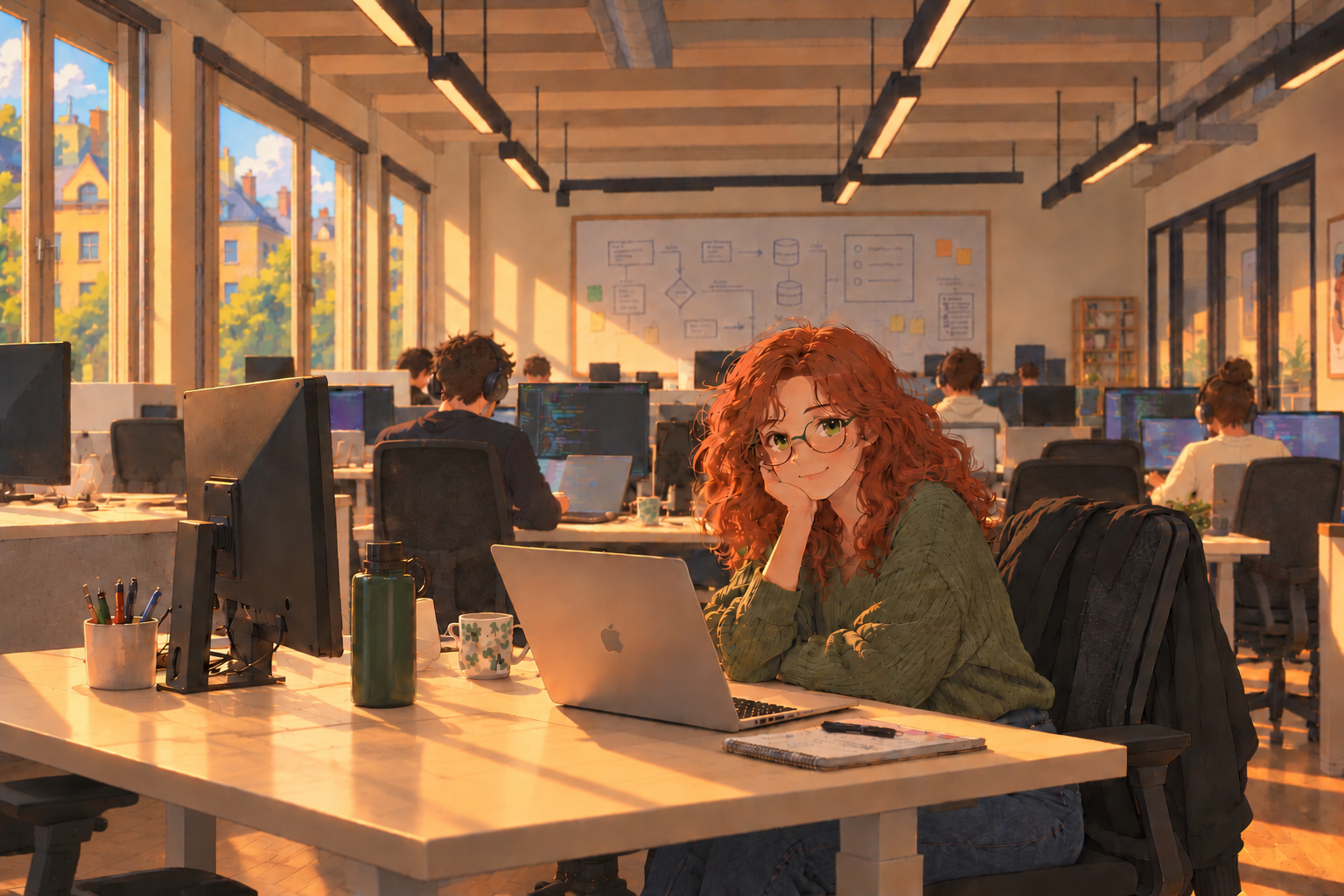
The office debate seems to never end, with lots of companies now demanding on-site work, both established corporations and fast-growing AI and tech startups. I see posts on social media from people who don’t understand why people want to work from home, while others state that they would quit immediately if their employer forced them back to the office full time.
I like working from the office. I enjoy the chit-chat, and I think that meetings and discussions are much better in real life. But I have a 50-minute commute, which costs me more than 8 hours a week, and children who need me.
I’ve experienced all three ways of working: fully office-based with no flexibility before the pandemic, fully remote, and hybrid. The pandemic changed my expectations of work and my view on what a good work–life balance could look like.
Companies face a difficult trade-off between the benefits of in-person collaboration and the assumption that being in the office leads to higher productivity, on the one hand, and employees’ work–life balance, focus, stress levels, and personal freedom on the other. For many engineers, working from home enables greater productivity through fewer interruptions and more time for focused work.
Comparing in-office work to remote work
Social
Much more fun and more casual chats and jokes at the office. When working remotely there’s less social chit-chat with colleagues and you don’t get to know them the same way. Just this last week I have had chats with colleagues about new AI tools, when and how to do laundry, the quality of jeans, and when my colleague saw Alexander Skarsgård bare-chested on a balcony.
When working from home you lose out on lots of the social chit-chat, but on the other hand you have much more time with a partner, family, friends and/or pets.
Time
A normal Stockholm 40-50 minute commute to the office means 7-8 hours a week spent on commuting if you’re in the office 5 days/week. That’s a whole extra working day on a train/bus instead of working, exercising or socializing. That’s a lot! Working from home frees up all that time for exercise, friends, family, hobbies and fun stuff instead.
Focus
Constant chatter from colleagues, people walking past, or loud arguments at the desk next to you make it hard to focus—especially for deep work like programming, writing, or learning. At home I can easily concentrate and put on background music to help.
There’s a lot of difference in opinion depending on whether someone is an introvert or extrovert and how demanding their work is. Of course it’s great to be able to ask questions whenever you feel like it. If your job mainly consists of low-focus work or talking, it’s no problem, and you can forget how it is to try to concentrate in that environment.
I have had several engineers state to me that they get less than 40% work done in the office compared to at home because of the constant interruptions and distractions. It’s great that designers, PMs, or sales and customer success can come by and ask quick questions, but we all know the cost of task switching, right? (One widely cited study of workplace behavior found that it took an average of 23 minutes and 15 seconds for interrupted work to be resumed.)

Trying to focus
Setup and comfort
I’m quite short. I’ve never had a chair and desk that’s the right height for me in an office. On top of that, I usually spend most of my days in meetings and all meeting room chairs and tables are too high for me, which makes them highly uncomfortable. At home I have an adjustable standing desk and a chair that fits me.
Health and stress
A friend pointed out that I should mention germs. I’ve never been as healthy as when I worked fully remote. I was never sick. On the subway and at the office I’m surrounded by sneezing and coughing people all the time.
There’s also a huge difference in stress levels. At the office there are people around you all the time and depending on your level of stress, introversion and shyness, days in the office, especially in an open-plan office, can mean a lot more stress for some people (links and reading below).
Teamwork
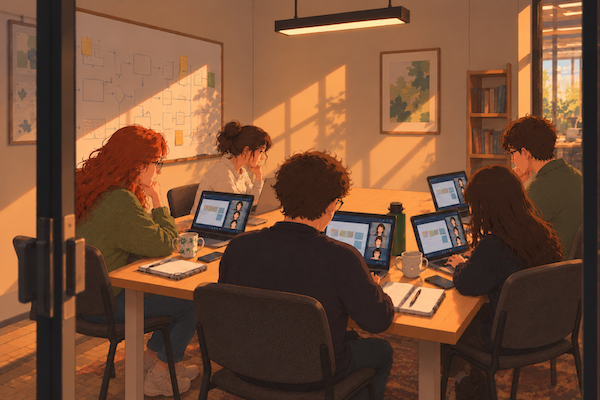
I definitely see a huge benefit from collaboration IRL. I personally notice a big difference in meetings and workshops when we’re all in the office versus hybrid meetings. In a hybrid meeting everyone stares at the screen instead of being present in the room, looking at each other and responding to whoever is talking. The meeting becomes awkward and less efficient.
At my current job we don’t have good conferencing equipment so hybrid meetings mean that everyone stares at their laptop instead of each other in the room. The sound is less than ideal, with sound and microphones from one of the laptops in the room. But even with a better setup with a good monitor and speakers everyone stares at the screen instead of each other in the room, which makes interactions unnatural. Fully remote meetings are better than hybrid, but IRL meetings are best.
Management perspective
As a manager, I benefit from seeing my direct reports and teams in the office. I can more easily pick up on whether someone looks stressed or upset, if someone starts being absent a lot, or if I notice that some colleagues aren’t getting along.
Most of my days are spent talking or in meetings, so I don’t suffer from the lack of focus as much as engineers do. That said, I do have work that requires concentration. I also have work I don’t want visible on my monitor in an open-plan office, which means I still need to find a quiet meeting room when I need to focus or do sensitive work.
Hybrid meetings
A comparison of an actual day for me
| In the office | Working from home | |
|---|---|---|
| 6:50 | Wake up. Shower, clothes, breakfast, getting kids ready for school. | Wake up. Shower, clothes, breakfast, getting kids ready for school. |
| 8:00 | Leave home and walk to the subway. Commute to the office, listening to an audio book or a podcast. At the office at 8:50. Unpack laptop and get ready. | Start working already at 8:00 or take a short walk to get some daylight and start working at 8:20. |
| 9:00 | Meetings and work. Have a fun chat with a colleague by our desks, but then get interrupted over and over again by colleagues when I try to focus. | Meetings and work, focus and silence. A quick ad-hoc chat with a colleague that needs help. |
| 10:30 | Quick 10 min break, go and get some coffee. Stare out the window. | Quick 10 min break, stretch for a bit or pay a bill and cuddle with a cat. |
| 12:00 | Go to the kitchen and eat my lunch box with some colleagues. Take a short walk on the streets near the office or get some work done while the office is quiet. | Cook something quick and healthy and eat. If my husband is at home, I get some quality time with him. Take a short walk in the forest nearby or start the washing machine to get some laundry done. |
| 13:00 | Meeting marathon starts again. Go between meeting rooms. | Meetings start again. I have a very cuddly and happy cat in my lap. |
| 14:30 | Quick 15 min break. Search the kitchen and hopefully find a sad apple in the fruit bowl. Text a friend. | Quick 15 min break. Eat some healthy snacks, unload the washing machine. |
| 15:00 | Try to focus while colleagues are joking about how often they wash their hair, or have a heated discussion about a database just behind me. I move to a small meeting room to be able to focus, straining my eyes at the small laptop screen instead of my monitor. Then more meetings. | Get work done quickly, have some time to read up on some new technologies we might want to use. More meetings. |
| 16:00 | Get texts from my children who are home from school with questions about when I will be home, if they can play video games, if they can go to a friend… Continue working. | Children come home from school, I can take a 5 minute break and hear about their day. Encourage them to do their homework while they still have some energy left. |
| 17:00 | Pack up and leave the office “early” to get home in time. Too tired to listen to my book, I can only stand some music after all the noise. Get home at around 17:50. | Close my laptop, since I started working earlier I’m already done for the day. Help kids with their homework while I cook dinner and get them ready for activities. |
| 18:00 | Cook dinner and then eat and/or get kids to activities. Some days one of them doesn’t have time to eat dinner before activities at 18:00 or 18:30. | Eat dinner with the family and talk about our day. Get kids to activities and then go for a run or do some strength training. |
| 19:00 | Dishes, help kids with homework – they are tired. Do laundry, pay bills and other admin stuff. | Dishes, talk to family, hopefully homework is already finished and we can watch a show or play some games. (Laundry and bills already done.) |
| 20:00 | Finish up some work. I have 30-60 min left of my workday and I’ve saved some focus work. One of the kids eats dinner after his activity and has some homework left to do but is too tired. | Play board games or video games with family, read or exercise. |
There’s a huge difference in time and getting my private life working, when I don’t have to commute.
Worst of both worlds - being in the office to have remote meetings
Several of my friends have the worst setup: their companies mandate four to five days of office presence, but their teams are spread across cities or countries. So they commute to the office just to sit through hybrid or remote meetings all day. They get the commute, the scramble for an empty room, and still end up in remote calls — without any of the benefits of being in the office or working remotely.
They aren’t alone. The Atlantic recently wrote about this phenomenon, calling it “in-office remote work.” It’s frustrating, and it’s growing.
In a September survey of 1,835 college-educated American workers, we found that, on their most recent day at the office, more than 70 percent of respondents had at least one member of their team who was not in the building with them. As a result, roughly half of respondents had no fully in-person meetings. And more than a third had exclusively online meetings because their teams moved meetings entirely online whenever anyone was remote.
What would be the ultimate setup?
Before I get to what I think works best, one caveat: this isn’t a universal answer. Junior people and new hires benefit from in-person mentorship and onboarding, parents without flexible hours face different trade-offs, and not everyone has a quiet room at home to work in. What follows is what works for me and my teams.
For me personally, a well-functioning hybrid setup would be best. I need the social interactions at the office, but I would truly benefit from less commute time and more focus time, so I don’t need to work in the evening and have more time for my family and hobbies. I would like a setup with fewer hybrid meetings and more intentional days: collaboration days and focus days.
For engineering teams, I think the ultimate setup would be two agreed days in the office with focus on collaboration, workshops, discussions with other teams and departments, then two or three focus days where people can work from home and lock in on the tasks they agreed on, without unneccessary interruptions, chatting with each other and collaborating remotely when needed. The office should of course stay open for anyone who wants to come in. Some people have problems focusing at home and some people need the daily social interactions in the office.
This is easier said than done. I’ve seen teams agree on specific office days, only to end up with at least one person working remotely most of the time. As a result, meetings and collaboration still happen in hybrid mode, creating frustration without delivering the benefits of being in the office or working remotely. I know that it’s possible and can work perfectly. It just takes some effort and collaboration.
More reading:
- Hybrid working from home improves retention without damaging performance (2024) https://www.nature.com/articles/s41586-024-07500-2
- A Cross-Sectional Survey on the Impact of Irrelevant Speech Noise on Annoyance, Mental Health and Well-being, Performance and Occupants’ Behavior in Shared and Open-Plan Offices (2019) https://doi.org/10.3390/ijerph16020280
- Open-plan office space? If you’re going to do it, do it right (2019) https://doi.org/10.1016/j.apergo.2019.102933
- Office Design’s Impact on Psychosocial Work Environment and Emotional Health (2024) https://pmc.ncbi.nlm.nih.gov/articles/PMC11050261/
- Effects of a Participative Workplace Intervention on Work Strategies and Expectations of Availability Among Office-Based Employees With Flexible Work Arrangements (2024) https://www.tandfonline.com/doi/full/10.1080/24725838.2024.2329109
- Hybrid working from home improves retention without damaging performance (2024) https://www.nature.com/articles/s41586-024-07500-2
- Worker interrupted, the cost of task switching https://www.fastcompany.com/944128/worker-interrupted-cost-task-switching
Swedish articles:
- Ökad risk för mobbning i öppna kontorslandskap (2026) https://forskning.se/2026/03/13/okad-risk-for-mobbning-i-oppna-kontorslandskap/
- Hybridarbete kan bli ett lyft för jobbet (2026) https://forskning.se/2026/08/18/hybridarbete-kan-bli-ett-lyft-for-jobbet/
- Kontorets design formar både arbetsmiljö och mående https://forskning.se/2026/02/16/kontorets-design-formar-bade-arbetsmiljo-och-maende/
- Så kan flexibelt arbete flyta på bättre (2024) https://forskning.se/2024/08/30/metoderna-som-far-distansarbetet-att-fungera/
- Många får mer gjort vid distansarbete (2023) https://forskning.se/2023/03/06/manga-far-mer-gjort-vid-distansarbete/
- Så blir kontoret ett lockbete för distansarbetare (2024) https://forskning.se/2024/08/27/sa-blir-kontoret-ett-lockbete-for-distansarbetare/
As always, this blog post is written by me, not an AI, so all errors are my own.